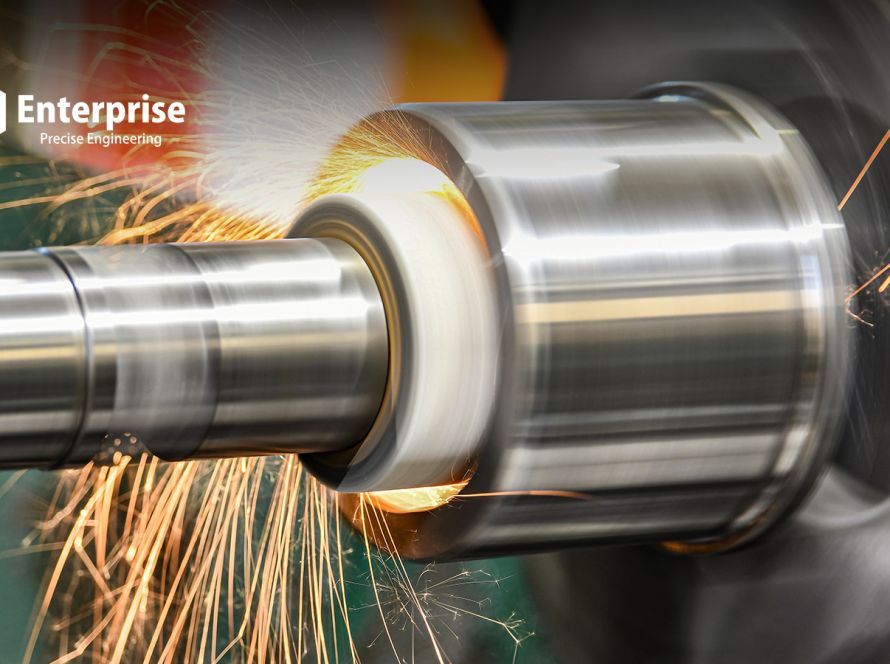
Precision grinding is one of the most important finishing processes in industrial engineering. Many manufacturers face challenges such as dimensional inconsistencies, surface finish limitations, and reduced component life after conventional machining. Precision grinding addresses these issues by enabling extremely tight tolerances, high dimensional accuracy, and superior surface finishes that are difficult to achieve through other methods. As industries move toward higher performance, longer service life, and zero-defect manufacturing, precision grinding has become a core process across advanced engineering sectors.
What Makes Precision Grinding Different
Precision grinding differs from conventional machining because it removes material at a microscopic level. This controlled material removal allows manufacturers to correct dimensional deviations, refine geometry, and achieve surface finishes that support optimal mechanical performance. The precision grinding process is particularly effective for hardened materials and components that require flawless alignment within complex assemblies.
Why Precision Grinding Is Crucial in Industrial Engineering
Industrial engineering demands components that fit accurately, perform reliably, and maintain stability under demanding operating conditions. Precision grinding supports these requirements by delivering micron-level accuracy, consistent repeatability, and excellent surface integrity. It minimizes dimensional variation, reduces friction between moving parts, and enhances fatigue resistance. This makes precision grinding essential for critical applications where even slight deviations can lead to performance failure, increased maintenance, or safety risks.
Major Precision Grinding Processes
● Industrial precision grinding applications rely on different processes based on component design and functional requirements.
● Surface grinding is used to produce flat and parallel reference surfaces that ensure accurate assembly and alignment.
● Cylindrical grinding ensures concentricity and uniform diameter in rotating components such as shafts and rollers.
● Internal grinding delivers precise internal geometries for housings, bushings, and bearing seats.
● Centerless grinding supports fast, high-volume production of cylindrical parts with excellent dimensional control and consistency.
● Profile grinding enables the production of complex shapes and contours required in advanced engineering designs and precision tooling.
● Each of these grinding processes contributes to achieving functional accuracy and repeatable quality across industrial systems.
● Surface grinding is used to produce flat and parallel reference surfaces that ensure accurate assembly and alignment.
● Cylindrical grinding ensures concentricity and uniform diameter in rotating components such as shafts and rollers.
● Internal grinding delivers precise internal geometries for housings, bushings, and bearing seats.
● Centerless grinding supports fast, high-volume production of cylindrical parts with excellent dimensional control and consistency.
● Profile grinding enables the production of complex shapes and contours required in advanced engineering designs and precision tooling.
● Each of these grinding processes contributes to achieving functional accuracy and repeatable quality across industrial systems.
Applications of Precision Grinding in Industrial Engineering:
1. Automotive Manufacturing
Precision grinding is widely used for engine components, transmission parts, gears, bearings, and shafts. These components require exact tolerances to ensure smooth motion, reduced wear, and improved fuel efficiency. Precision grinding enhances reliability and extends service life in high-stress automotive systems.
2. Aerospace Engineering
In aerospace applications, precision grinding is critical for turbine components, landing gear parts, and structural elements. These components operate under extreme temperature and pressure conditions, making dimensional accuracy and surface quality essential for operational safety and long-term performance.
3. Medical Engineering
Medical devices and implants require exceptionally smooth surfaces and precise dimensions. Precision grinding enables the manufacture of surgical instruments, orthopaedic implants, and dental components that meet strict quality, hygiene, and biocompatibility standards.
4. Tool and Die Manufacturing
Precision grinding is used extensively in the production and sharpening of cutting tools, dies, and moulds. High-accuracy edges and consistent profiles improve machining performance, enhance repeatability, and extend tool life.
5. Industrial Machinery and Equipment
Heavy machinery components, such as hydraulic components, large bearings, and precision shafts, rely on precision grinding for durability and load-bearing accuracy. The process improves wear resistance, dimensional stability, and smooth operation in demanding industrial environments.
Advantages of Precision Grinding in Industrial Engineering
● Precision grinding delivers consistent accuracy even for complex or hardened components.
● It improves surface quality, reducing friction, vibration, and energy loss during operation.
● It supports tight tolerance requirements essential for advanced engineering systems.
● It enhances component reliability, fatigue strength, and overall service life.
● It enables scalable production without compromising quality or repeatability.
● It improves surface quality, reducing friction, vibration, and energy loss during operation.
● It supports tight tolerance requirements essential for advanced engineering systems.
● It enhances component reliability, fatigue strength, and overall service life.
● It enables scalable production without compromising quality or repeatability.
Role of Precision Grinding in Modern Manufacturing
As industrial engineering continues to evolve toward automation, lightweight designs, and high-speed systems, the role of precision grinding is expanding. It complements CNC machining by refining parts to their final specifications and ensuring they match digital design intent. In many industries, precision grinding is no longer optional but a necessary process for maintaining competitive manufacturing standards and consistent product quality.
Conclusion
Precision grinding is a cornerstone of industrial engineering applications where accuracy, performance, and durability are essential. By delivering precise dimensions, superior surface finishes, and reliable repeatability, it ensures components meet the demanding requirements of modern industrial systems. For manufacturers focused on quality leadership, operational efficiency, and long-term reliability, precision grinding remains an essential investment in high-precision manufacturing.